
Rise of Digital Payments
Digital payments, or in other words the evolution of money, has undergone a structural change in the last decade, especially in the field of payment systems.
Digital payments, or in other words the evolution of money, has undergone a structural change in the last decade, especially in the field of payment systems.
Consumer behaviour is changing day by day, of course, the Covid-19 pandemic has a big share (perhaps accelerating effect) in this. Payments are transitioning towards more contactless and cashless transactions. Of course, this transition is accelerating as the impact of COVID-19 is felt more and more.
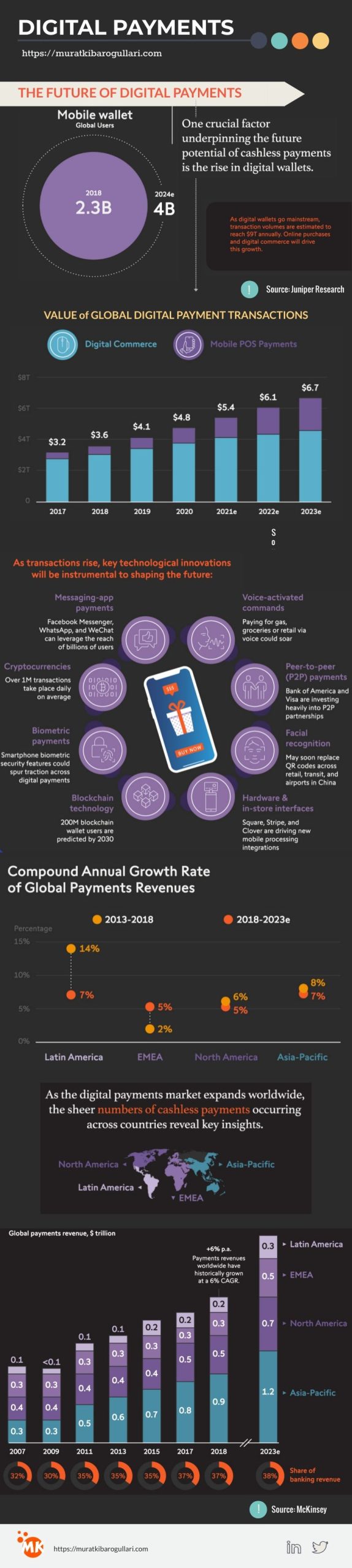
On the chart below, you can take a look at the digital payments ecosystem from a global perspective. With the discovery and widespread use of innovative technologies, we can see how digital payments continue to grow as the preferred solution for trillions of dollars of transactions each year.
A Short History
The origins of digital payments began more than 25 years ago, when Dan Kohn, a 21-year-old entrepreneur from Nashua, New Hampshire, USA, sold a CD over the Internet using credit card payment.
1994: First online purchase made
Sting’s Ten Summoner’s Tales CD sells for $12.48 on NetMarket.
1997: First mobile payments and first contactless payments
Coca-Cola installs two vending machines in Helsinki that accept payment by text message.
1999: Paypal launched its electronic money transfer service
Early on, PayPal’s user base grew by about 10 per cent every day. Tesla CEO Elon Musk and venture capitalist Peter Thiel were among its co-founders.
2003: Alibaba launches Alipay in China
Today, the mobile payment platform has witnessed tremendous growth, leveraging digital wallets accepted by businesses in more than 50 countries and territories.
2007: M-PESA created the first payment system for mobile phones
Kenya-based M-PESA launched its mobile banking and micro-finance service. Today, it has more than 37 million active users on its platform in Africa.
2009: Bitcoin enables secure, untraceable payments
Satoshi Nakamoto develops the world’s first decentralised payment network.
2013: WeChat Pay is added to the popular messaging platform
As of 2018, it exceeded 800 million monthly active users.
2014: Apple Pay is launched
By 2023, more than US$2 trillion of mobile payment transactions could be verified with biometric technology.
While countless technological developments based on innovation appear before us every day, developments in digital payment technologies are creating a ripple effect globally.
The Future of Digital Payments
As the number of transactions increases, innovative technological changes can have a significant impact in shaping the development of the digital payments industry:
Messaging app payments
Facebook Messenger, WhatsApp and WeChat can benefit from the reach of billions of users.
Voice-activated commands
Paying by voice at petrol stations, convenience stores or retail outlets can increase rapidly.
Peer-to-peer (P2P) payments
Bank of America and Visa are heavily investing in P2P partnerships.
Cryptocurrencies
On average, more than one million transactions take place daily.
Biometric payments
Biometric security features on smartphones could boost digital payments.
Face recognition
It may soon even replace QR codes in retail, public transport and airports in China.
Use of crypto wallets in payments
Blockchain wallet users are predicted to rise to 200 million by 2030.
Hardware-based in-store payment acceptance points
Square, Stripe and Clover support new mobile processing integrations.
The $4.1 trillion digital payments ecosystem is facing a period of significant transition, catalysed by a global pandemic and its impact. As the payments industry continues to expand its reach and ecosystem, businesses, consumers and market players can reap critical benefits from the transition to a cashless economy.
The Rise and Future of Digital Payments
Published by: Fintech Expert Murat Kibaroğlulları
